
Utilized, Militarized, Shielded: Three reasons why settler violence is state violence
Utilized, Militarized, Shielded: Three reasons why settler violence is state violence
UN Human Rights - OPT
Reason one: utilized
Settler violence as a spearhead of annexation
Settler violence is effectively being used to advance the stated Israeli policy of “maximum territory with minimum population,” in the words of the Israeli Minister of Finance and additional Minister in the Ministry of Defense — a policy whose implementation is evident in the growing dispossession of Palestinians to make way for unprecedented Israeli settlement expansion.
The northern Jordan Valley, primarily inhabited by Palestinian herding and farming communities, is emblematic of a pattern of settler violence going hand in hand with plans stated by the Israeli government: Palestinians’ dispossession persist for years → outposts increase → "Crimson Thread" separation barrier is announced → settler attacks are increasingly launched from outposts against nearby Palestinian communities → communities are forced to displace, leaving land empty → planned project proceeds on “empty” land → outposts are legalized and given infrastructure.
In late 2025, the Israeli government announced plans to construct a new separation barrier under the name of the “Crimson Thread” whose full length would stretch from the Golan Heights to the Red Sea. The segment of the new barrier already under construction will consolidate the annexation of the northern Jordan Valley by connecting it to Israel along the northern Green Line, while severing it entirely from the rest of the occupied West Bank. So far, settler violence has fully or partially displaced ten communities across the northern Jordan Valley, both along the route of the planned barrier and east of it.
Witness accounts from across the northern Jordan Valley have consistently pointed to an increasing level of settlers’ use of sexual harassment and assault to drive residents out, as well as arson attacks, theft of livestock, assaults on children, and deliberately depriving Palestinians of access to water sources and grazing land.
“Harassment by settlers increased: they would drive their ATVs (All-Terrain Vehicles) through our community, entering between our homes and frightening our children. My children started having nightmares because of them,” a Palestinian father of five said about his displacement from Hamamat Al Malih to Khirbet Yarza.
Israeli authorities delivered a map of land confiscation orders along the route of the planned Crimson Thread to the affected Palestinian communities in November 2025. It demonstrated that the residents of Khirbet Yarza would have been entirely encircled by the barrier, cut off from the rest of the West Bank. But no Palestinians are left in Khirbet Yarza today. Settler attacks on Khirbet Yarza residents intensified over months, with the support, acquiescence, and participation of Israeli security forces, forcing families to flee one by one.
By March 2026, the last of the 13 families that had remained in the community dismantled their homes and took their livestock and left. With them was the herder from Hamamat Al Malih, forced to leave with his family a second time, this time to nearby Einun. He later said that a settlement security guard found him in Einun and said settlers will continue to attack his family until they leave Area C — an experience commonly reported by displaced families who said they were tracked by settlers and/or soldiers from one community to the next with constant threats that they should leave Area C altogether.
Map of Israeli land seizure orders along the route of the "Crimson Thread" barrier in the northern Jordan Valley
Israeli authorities delivered a map of land seizure orders along the route of the "Crimson Thread" in the northern Jordan Valley to affected Palestinian communities in November 2025.
Violence and harassment by Israeli settlers and soldiers has driven Palestinians out of Hamamat Al Malih, with the last group of families displaced in March 2026.
The school in Hamamat Al Malih served several surrounding herding communities. After the community was displaced in March 2026, Israeli settlers raided the school and raised Israeli flags on the building, and later demolished it in April 2026.
Khirbet Yarza residents would have been entirely encircled by the barrier.
However, violence and harassment by Israeli settlers and security forces led to the displacement of every last Palestinian in the community by March 2026.
Violence and harassment by Israeli settlers and soldiers has also driven Palestinians out of Aqabat Tayasir - East, with the last group of families displaced in April 2026.
Since January 2023, 6,200 Palestinians, including more than 3,000 children, have been displaced due to settler attacks and related access restrictions across 119 communities. These include more than 3,600 people displaced from 46 communities that have become fully emptied of their Palestinian residents.(Source: OCHA)
Northern Jordan Valley communities are still facing the threat of forced displacement every day due to persistent, unchecked settler violence.
Former residents of Khirbet Yarza said that most of the settler attacks that displaced them were led by a settler well known to the residents who had founded the nearby Tzvi HaOfraim outpost.
All settlements are illegal under international law, but settler outposts are illegal even under Israeli law. Yet, since 7 October 2023, settlers have established at least 215 outposts like Tzvi HaOfraim across the occupied West Bank, with Israeli authorities ensuring adequate infrastructure. This is a dramatic increase from an annual average of eight outposts in the decade before 2023.
Not yet legalized, Tzvi HaOfraim already has access to water and electricity, is provided security by Israeli forces, and enjoys a separate paved road.
The Israeli Government is also increasingly legalizing outposts retroactively. According to Israeli media, seven of the 34 new settlements approved in April 2026 already existed as outposts in the Jordan Valley.
“Starting June 2025, settlers placed many mobile homes on Jabal Al Salma, located between Khirbet Ibziq and Raba village, on a land confiscated by Israeli soldiers for ‘military purposes’. From that outpost, settlers and soldiers carried out their attacks on our community,” a father of seven from Khirbet Ibziq community in the northern Jordan Valley said.
Like Khirbet Yarza, Khirbet Ibziq was also entirely emptied of Palestinians due to relentless Israeli settler and security forces’ violence. Har Bezeq, the outpost described by the father of seven, was legalized by the Israeli government in December 2025.
Reason two: militarized
Erosion of the line separating settler from soldier
“At night, I used to see soldiers roaming with settlers dressed in civilian clothing, harassing and assaulting Palestinians. During the day, I would see the same people in uniform, operating the Tayasir checkpoint, also harassing and assaulting Palestinians. They would sometimes come together from the outpost next to the checkpoint and threaten to force me out of my home,” said a herder who was eventually forcibly displaced from Khirbet Yarza.
Across the West Bank, Palestinians are reporting similar attacks by “settlers in uniform”: settlers in partial or full uniform carrying state-issued assault rifles, attacking together with Israeli soldiers.
Settler violence is not only utilized by the Israeli government, but settlers are also increasingly absorbed into formal state forces or armed, funded, and allowed to effectively operate as an extension of these forces.
a. Enlisting settlers as reservist soldiers in Regional Defense Battalions
On 7 March 2026, a group of settlers grazed their cattle on Palestinian-owned land in Wadi ar Rakhim, south Hebron Hills and assaulted the owners, a 75-year-old father and his two sons aged 28 and 33, injuring the father. A settler known to the residents from previous attacks arrived in military uniform, armed with a rifle, and shot the two sons while attempting to aid their father, killing the 28-year-old.
The shooter was later identified as a member of the Israeli Regional Defense Battalions known as “Hagmar” which include thousands of enlisted settlers operating as reservist soldiers in the occupied West Bank. At least seven Palestinians have been killed by settlers who are also members of Hagmar and/or off-duty settlers in mob attacks and raids on neighboring Palestinian communities since the start of 2026.
b. Massive increase in distribution of military firearms to settlements’ Emergency Response Squads and civilians
On 13 October 2023, a member of an Israeli “Emergency Response Squad” descended from his outpost to the Palestinian village of At-Tuwani, south Hebron Hills, with a military-grade rifle and shot a Palestinian man in the abdomen, point blank.
In addition to enlisting settlers as reservists in the units known as Hagmar, the Israeli government has also organized settlers into “Kitat Konenut” units or “Emergency Response Squads” — largely funded and armed by the government, particularly, the Israeli ministries of Defense and National Security, in addition to privately raised funds from all over the world.
Since 7 October 2023, Israeli authorities provided more arms to Kitat Konenut members and effectively gave them a free hand to operate outside of settlements. For example, the Minister of National Security distributed 10,000 newly purchased assault rifles among Kitat Konenut members in late 2023, with additional weapons procured by Settlement Regional Councils —official Israeli municipal bodies— including through international fundraising campaigns.
Since 7 October 2023, Israeli authorities have also donated ATVs to settlements and outposts, and relaxed gun licensing regulations for Israelis, including settlers in the occupied West Bank, with 230,000 new gun permits reportedly granted by November 2025.
While Kitat Konenut members are not issued uniforms, they often appear in uniforms because many are also members of Hagmar forces.
c. Israeli security forces participate in settler attacks
The entanglement is compounded by the now routine support and participation of Israeli security forces in settler attacks. In 2025, 240 Palestinians were killed by Israeli security forces and settlers, including 225 by Israeli security forces, eight by settlers, and seven killed in joint attacks by settlers and Israeli security forces shooting together, making definitive attribution impossible.
Settlers are increasingly participating in Israeli security forces’ activities such as conducting searches of Palestinians, patrolling, setting up informal checkpoints, and even carrying out demolitions of Palestinian structures. There is also an emerging alarming trend of settlers abducting Palestinians and detaining them for hours or days, later handing them over to Israeli security forces or releasing them with signs of physical assault and ill-treatment.
In the final days before Khirbet Yarza in the northern Jordan Valley was entirely emptied of Palestinians, settlers stormed the community on 4 March, assaulted residents and vandalized their property. Soon after, Israeli security forces arrived and detained three Palestinian families on site while settlers beat them. When an ambulance arrived to pick up the injured, Israeli security forces obstructed it while settlers assaulted the driver and paramedic.
A few days later, the last remaining Palestinian families in the nearby Aqabat Tayasir community were packing to leave after a similar attack. A 33-year-old man later said that an Israeli soldier approached him while dismantling his tent and said: “Remember when I asked you to leave nicely and you didn’t listen? This is the result.”
“At night, I used to see soldiers roaming with settlers dressed in civilian clothing, harassing and assaulting Palestinians. During the day, I would see the same people in uniform, operating the Tayasir checkpoint, also harassing and assaulting Palestinians. They would sometimes come together from the outpost next to the checkpoint and threaten to force me out of my home,” said a herder who was eventually forcibly displaced from Khirbet Yarza.
Across the West Bank, Palestinians are reporting similar attacks by “settlers in uniform”: settlers in partial or full uniform carrying state-issued assault rifles, attacking together with Israeli soldiers.
Settler violence is not only utilized by the Israeli government, but settlers are also increasingly absorbed into formal state forces or armed, funded, and allowed to effectively operate as an extension of these forces.
a. Enlisting settlers as reservist soldiers in Regional Defense Battalions
On 7 March 2026, a group of settlers grazed their cattle on Palestinian-owned land in Wadi ar Rakhim, south Hebron Hills and assaulted the owners, a 75-year-old father and his two sons aged 28 and 33, injuring the father. A settler known to the residents from previous attacks arrived in military uniform, armed with a rifle, and shot the two sons while attempting to aid their father, killing the 28-year-old.
The shooter was later identified as a member of the Israeli Regional Defense Battalions known as “Hagmar” which include thousands of enlisted settlers operating as reservist soldiers in the occupied West Bank. At least seven Palestinians have been killed by settlers who are also members of Hagmar and/or off-duty settlers in mob attacks and raids on neighboring Palestinian communities since the start of 2026.
b. Massive increase in distribution of military firearms to settlements’ Emergency Response Squads and civilians
On 13 October 2023, a member of an Israeli “Emergency Response Squad” descended from his outpost to the Palestinian village of At-Tuwani, south Hebron Hills, with a military-grade rifle and shot a Palestinian man in the abdomen, point blank.
In addition to enlisting settlers as reservists in the units known as Hagmar, the Israeli government has also organized settlers into “Kitat Konenut” units or “Emergency Response Squads” — largely funded and armed by the government, particularly, the Israeli ministries of Defense and National Security, in addition to privately raised funds from all over the world.
Since 7 October 2023, Israeli authorities provided more arms to Kitat Konenut members and effectively gave them a free hand to operate outside of settlements. For example, the Minister of National Security distributed 10,000 newly purchased assault rifles among Kitat Konenut members in late 2023, with additional weapons procured by Settlement Regional Councils — official Israeli municipal bodies — including through international fundraising campaigns.
Since 7 October 2023, Israeli authorities have also donated ATVs to settlements and outposts, and relaxed gun licensing regulations for Israelis, including settlers in the occupied West Bank, with 230,000 new gun permits reportedly granted by November 2025.
While Kitat Konenut members are not issued uniforms, they often appear in uniforms because many are also members of Hagmar forces.
c. Israeli security forces participate in settler attacks
The entanglement is compounded by the now routine support and participation of Israeli security forces in settler attacks. In 2025, 240 Palestinians were killed by Israeli security forces and settlers, including 225 by Israeli security forces, eight by settlers, and seven killed in joint attacks by settlers and Israeli security forces shooting together, making definitive attribution impossible.
Settlers are increasingly participating in Israeli security forces’ activities such as conducting searches of Palestinians, patrolling, setting up informal checkpoints, and even carrying out demolitions of Palestinian structures. There is also an emerging alarming trend of settlers abducting Palestinians and detaining them for hours or days, later handing them over to Israeli security forces or releasing them with signs of physical assault and ill-treatment.
In the final days before Khirbet Yarza in the northern Jordan Valley was entirely emptied of Palestinians, settlers stormed the community on 4 March, assaulted residents and vandalized their property. Soon after, Israeli security forces arrived and detained three Palestinian families on site while settlers beat them. When an ambulance arrived to pick up the injured, Israeli security forces obstructed it while settlers assaulted the driver and paramedic.
A few days later, the last remaining Palestinian families in the nearby Aqabat Tayasir community were packing to leave after a similar attack. A 33-year-old man later said that an Israeli soldier approached him while dismantling his tent and said: “Remember when I asked you to leave nicely and you didn’t listen? This is the result.”

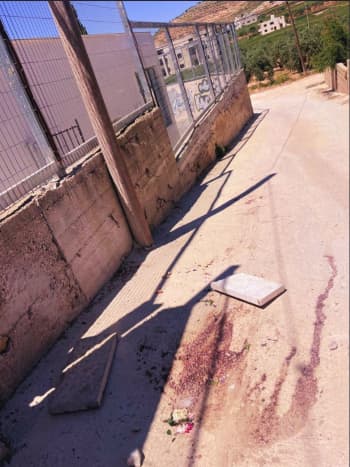
14-year-old Aws Naasan was killed outside his school in Al Mughayyir in April 2026 by a settler later identified as a Hagmar member. Photo: UN Human Rights - OPT.
14-year-old Aws Naasan was killed outside his school in Al Mughayyir in April 2026 by a settler later identified as a Hagmar member. Photo: UN Human Rights - OPT.

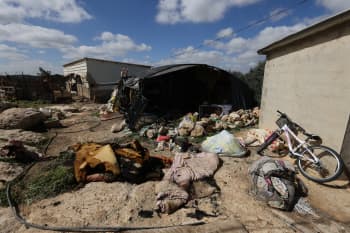
The aftermath of a settlers' arson attack in south Hebron Hills. Photo: UN Human Rights OPT - Alaaeddin Saleh.
The aftermath of a settlers' arson attack in south Hebron Hills. Photo: UN Human Rights OPT - Alaaeddin Saleh.

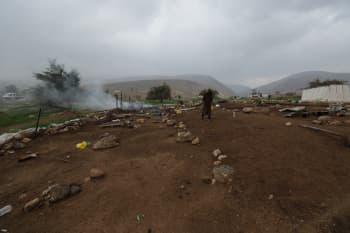
A Palestinian farmer forced to leave his land after a settler attack, Al Ouja, Jericho, January 2026. Photo: UN Human Rights OPT - Alaaeddin Saleh.
A Palestinian farmer forced to leave his land after a settler attack, Al Ouja, Jericho, January 2026. Photo: UN Human Rights OPT - Alaaeddin Saleh.
Reason three: shielded
Systematic impunity ensures settler violence grows unchecked
In April 2025, a settler shot 60-year-old Saed Al Amur in the leg on his land in Al Rakeez, Masafer Yatta, southern Hebron Hills, leading to amputation. Settlers had repeatedly attacked Saed’s land despite all his attempts to protect it. When he built a gate and a fence, they took them down. When he encircled it with rocks, they removed them. When he filed an official complaint with the Israeli authorities, nothing changed.
Until the day Saed was shot by Israeli settlers and had his leg amputated. A few days later, he and his 16-year-old son were the ones on trial in an Israeli court for assault.
On the day of the shooting, Saed said that he rushed with his 16-year-old son to their land when settlers started digging holes to erect poles that would have made part of the land inaccessible to its owners. One settler grabbed the son by the neck, another shot Saed in the leg when he tried to rescue the boy. When Israeli soldiers arrived, they detained the 16-year-old and took him to an Israeli military prison, physically assaulting him on the way. An Israeli ambulance evacuated Saed after more than half an hour of bleeding to Soroka Hospital in Israel.
Saed later said that he was shackled to his hospital bed throughout his stay, during which he underwent two surgeries and ultimately had his leg amputated above the knee. Both Saed and his son were then taken to court, accused of assaulting Israelis. When video evidence was presented that showed they were the assaulted party, they were released on bail of 5,000 Israeli shekels, equivalent to over 1,300 USD, pending further prosecution.
The shooter was known to Saed’s family from previous attacks — a settler who is also a settlement security coordinator. He used an M16 assault rifle, commonly used by Israeli soldiers. He faced no legal consequences.
This asymmetry is integral to Israel’s system of dominance and racial segregation in the occupied territory with a legal system that does not treat Palestinians as holders of a right to legal protection. The continuation of unchecked violence by settlers and Israeli forces cannot be separated from this architecture.
Overall, according to the Israeli human rights organization Yesh Din, 58.3% of Palestinian victims of crimes committed by settlers since 7 October 2023 chose not to file complaints, pointing to futility and mistrust in the Israeli justice system. Between 2005 and 2025, nearly 94% of all investigations initiated against settlers for crimes against Palestinians were closed. Only 3% of all such investigations resulted in full or partial convictions.
As their land is re-engineered around them, Palestinians are left with no lines of defence or protection. Journalists and anti-occupation activists are detained and tortured or ill-treated; civil society organizations are raided and restricted; human rights organizations are banned and sanctioned; speech, including on social media, is monitored and penalized.
Recently, Israeli security forces have also intensified the crackdown on the last available line of defence: international solidarity activists who stay with vulnerable communities to deter attacks and bear witness to violations. Witness accounts, from Palestinians or international activists, no longer appear to deter violence, which escalates regardless of protective presence, abundant documentation, and mounting evidence.
The decades-long impunity is a permanent feature of Israel’s broader conduct in the occupied territory. Israeli security forces have killed over 1,000 Palestinians since October 2023 in the occupied West Bank, without a single conviction for these killings. In fact, the last conviction of an Israeli member of formal state forces for the killing of a Palestinian in the West Bank was back in 2020, carrying a sentence of three months of military service and three months of suspended jail time.
This evident dehumanization of Palestinians and disregard for their lives is most striking when compared to the consequences faced by Palestinians when involved or suspected of involvement in violence against settlers. Many are killed on the spot, followed by collective punishment against their communities, including lockdowns and demolition of their family homes, and a 2024 law authorizing the deportation of their relatives, including parents, siblings, and children, to Gaza or abroad for up to 20 years.
Most recently, the Israeli Knesset passed a law that provides for military courts to impose the death penalty on Palestinians in the occupied West Bank for certain offences, including killing settlers, while explicitly exempting “Israeli citizens or residents of Israel” from these provisions entirely, including for killing Palestinians.
In April 2025, a settler shot 60-year-old Saed Al Amur in the leg on his land in Al Rakeez, Masafer Yatta, southern Hebron Hills, leading to amputation. Settlers had repeatedly attacked Saed’s land despite all his attempts to protect it. When he built a gate and a fence, they took them down. When he encircled it with rocks, they removed them. When he filed an official complaint with the Israeli authorities, nothing changed.
Until the day Saed was shot by Israeli settlers and had his leg amputated. A few days later, he and his 16-year-old son were the ones on trial in an Israeli court for assault. The attacking settlers were not detained, questioned, or charged.
On the day of the shooting, Saed said that he rushed with his 16-year-old son to their land when settlers started digging holes to erect poles that would have made part of the land inaccessible to its owners. One settler grabbed the son by the neck, another shot Saed in the leg when he tried to rescue the boy. When Israeli soldiers arrived, they detained the 16-year-old and took him to an Israeli military prison, physically assaulting him on the way. An Israeli ambulance evacuated Saed after more than half an hour of bleeding to Soroka Hospital in Israel.
Saed later said that he was shackled to his hospital bed throughout his stay, during which he underwent two surgeries and ultimately had his leg amputated above the knee. Both Saed and his son were then taken to court, accused of assaulting Israelis. When video evidence was presented that showed they were the assaulted party, they were released on bail of 5,000 Israeli shekels, equivalent to over 1,300 USD, pending further prosecution.
The shooter was known to Saed’s family from previous attacks — a settler who is also a settlement security coordinator. He used an M16 assault rifle, commonly used by Israeli soldiers. He faced no legal consequences.
This asymmetry is integral to Israel’s system of dominance and racial segregation in the occupied territory with a legal system that does not treat Palestinians as holders of a right to legal protection. The continuation of unchecked violence by settlers and Israeli forces cannot be separated from this architecture.
Overall, according to the Israeli human rights organization Yesh Din, 58.3% of Palestinian victims of crimes committed by settlers since 7 October 2023 chose not to file complaints, pointing to futility and mistrust in the Israeli justice system. Between 2005 and 2025, nearly 94% of all investigations initiated against settlers for crimes against Palestinians were closed. Only 3% of all such investigations resulted in full or partial convictions.
As their land is re-engineered around them, Palestinians are left with no lines of defence or protection. Journalists and anti-occupation activists are detained and tortured or ill-treated; civil society organizations are raided and restricted; human rights organizations are banned and sanctioned; speech, including on social media, is monitored and penalized.
Recently, Israeli security forces have also intensified the crackdown on the last available line of defence: international solidarity activists who stay with vulnerable communities to deter attacks and bear witness to violations. Witness accounts, from Palestinians or international activists, no longer appear to deter violence, which escalates regardless of protective presence, abundant documentation, and mounting evidence.
The decades-long impunity is a permanent feature of Israel’s broader conduct in the occupied territory. Israeli security forces have killed over 1,000 Palestinians since October 2023 in the occupied West Bank, without a single conviction for these killings. In fact, the last conviction of an Israeli member of formal state forces for the killing of a Palestinian in the West Bank was back in 2020, carrying a sentence of three months of military service and three months of suspended jail time.
This evident dehumanization of Palestinians and disregard for their lives is most striking when compared to the consequences faced by Palestinians when involved or suspected of involvement in violence against settlers. Many are killed on the spot, followed by collective punishment against their communities, including lockdowns and demolition of their family homes, and a 2024 law authorizing the deportation of their relatives, including parents, siblings, and children, to Gaza or abroad for up to 20 years.
Most recently, the Israeli Knesset passed a law that provides for military courts to impose the death penalty on Palestinians in the occupied West Bank for certain offences, including killing settlers, while explicitly exempting “Israeli citizens or residents of Israel” from these provisions entirely, including for killing Palestinians.
 Built with Shorthand